You have a great idea for a product, perhaps you already have a sketch, or maybe not. Now you want to have it manufactured. What do you send to the factory?
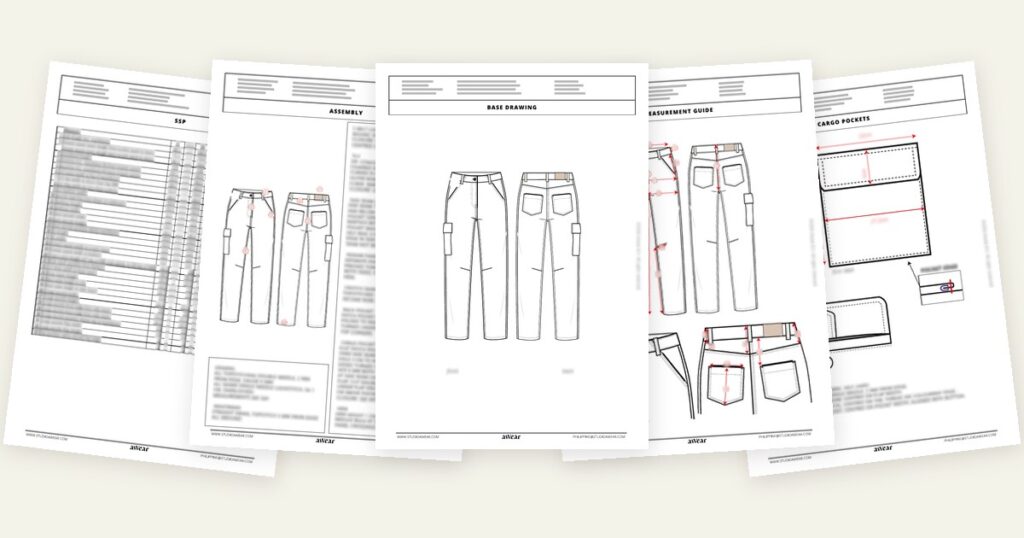
A mood board, a sketch, and a brief are a good start, but they don’t tell the people at the factory exactly what needs to be done, such as where a seam is placed, how wide the hem should be, or which material to use for the lining. For that, you need a tech pack.
You can think of a tech pack as the blueprint for your product. An architect doesn’t just create a sketch of a house; the blueprint also specifies the materials used, the structural details, the routing of pipes and wiring, and the dimensions. The same applies to fashion products in a tech pack.
What does a tech pack consist of?
There is no standard format, which leads to significant variations in the quality of tech packs, ranging from a simple Excel sheet with a line drawing and a few measurement points to a fully detailed production dossier.
In principle, a tech pack should include the following components:
- Technical drawings
Front and back views of the product, along with any necessary detail drawings.
These are not mood images or rough sketches, but technical black-and-white line drawings that clearly show the product’s construction. - Size chart and grading
A complete overview of measurement points for each size, including the corresponding tolerances. These are the specific measurements the factory uses to create an accurate pattern for the product. - Construction
Details on the specific types of seams used and how they should be finished. This ensures the final product meets the technical quality standards required for your item. - Materials
Specifications regarding which materials are to be used and where. - Trims
Zippers, buttons, laces, snap fasteners, elastic, cords, tapes, etc. - Color variants
Each color variant per style is detailed and colored. Specifications for each component include the material color code or Pantone numbers, ensuring the factory knows the exact color required and cannot rely on its own interpretation. - Labels and artwork
Brand labels, care labels, size labels, embroidered logos or artwork, etc. - Packaging
Poly bags, hangtags, shipping packaging, folding instructions.
All of this applies to clothing. Tech packs for shoes and bags often look slightly different. For shoes, information regarding the last and the sole is crucial for the shoe’s construction.
For bags, a technical drawing of the interior (including compartments) is a key element.
Although the structure varies by product type, the fundamental principle remains the same: the tech pack must contain everything the factory needs to manufacture the product correctly.
Why all this matters.
If you don’t specify something, the factory decides for you. They won’t always choose the path you would have taken; instead, they might opt for a faster or cheaper solution.
No tolerances in your size chart? All sorts of variations can occur within the same size during bulk production.
No material weight specified? Your supplier will often choose the cheapest quality available within the requested composition.
The result?
Your first sample arrives, and you are disappointed. It doesn’t match the vision you had in mind, and you need several more rounds of adjustments to achieve a successful final product.
Does a good tech pack guarantee that the first sampling round goes 100% right? No, not always. It does prevent numerous rounds of sampling, rounds that cost both money and a great deal of time.
When do you need a tech pack?
Do I need a tech pack if I only want to produce a small batch?
Yes; the size of your production run doesn’t affect the quality of the final product. You still want consistent production, whether it involves 50 units or 5,000.
Can’t I just send a photo and a size chart to the factory?
You can; some factories accept that. Working with less detail means having fewer control points during production.
Can’t I use AI to create a tech pack?
Of course, the technology is improving every day, and today’s results are far better than those from a month ago. There are two things to keep in mind. AI primarily works with existing information, resulting in a lot of generic information. If you have a truly novel idea, it is much harder to flesh it out using AI.
The quality of an item often lies in the details, technical drawings of details and unique finishes. The AI-generated tech packs we see these days tend to be very concise and often lack these details.
Can I use AI for anything than?
Absolutely. It is an excellent tool for putting your ideas down on paper in a briefing. Just make sure you read through it yourself. AI-generated briefings are often long-winded, spanning 10 to 20 pages, whereas a good product briefing should be no more than two pages.
At what stage of the process do you create a tech pack?
This happens after the concept and design phases, but before you approach a factory or request a sample.
Who creates a tech pack?
- If you have the expertise, you can do it yourself.
- You can have it created by a technical designer or a design studio specializing in technical design.
- You can have the factory do it. Some factories offer this service. Be aware, however, that this makes you dependent on that specific factory, and you can’t easily switch factories.
The next step.
The tech pack is not the end goal.
It is a tool to get a grip on the sampling and production processes. During production, independent parties like SGS also use the tech pack to verify that production is proceeding correctly and that everything is being manufactured exactly as specified. At Studio Awear, we create tech packs for clothing, footwear, bags, and accessories. Everything we deliver is production-ready, in English, and yours to use for manufacturing wherever you choose.
Want to know more about what our tech pack design service entails? Check out the tech pack page.